Remembering Jake Copass
By Kay McWilliams
The anniversary of Jake’s passing has arrived again; June 8th marks two decades. “I can’t believe it’s been twenty years since my dad left us,” his daughter, Norma, says, “But in so many ways, he never truly left. His presence is still felt everywhere, especially at the Alisal Guest Ranch.” Norma knows firsthand what others know from meeting him as guests of the ranch. “Jake touched generations of guests who visited, and continue to visit, the ranch,” she adds, “whether through horseback rides, rodeos, or simply sharing stories around the grounds. He left a lasting impression on so many people and is deeply missed in countless ways.” Those who knew him well, carry something of Jake with them still.
To the guests he conversed with, rode with, and entertained, Jake was their connection to the real deal, a working cowboy up close and personal. His Texan drawl made whatever came out of his mouth sound more authentically cowboy because no one else around here talked like that. To those of us who worked with him, he possessed a plethora of ranching wisdom delivered from a well of wit. Whenever Jake was in the corral, you knew you were bound to laugh as well as learn something. When he told a funny story, Jake punctuated it with his own signature infectious laugh, and seeing his twinkling glance, his listeners would laugh all the more. He knew no strangers. At times he might have a strong opinion on something, and he’d let you know that too, no matter who you were. The Alisal guests who became close to Jake over the many years they have visited the ranch, still consider him family, never to be forgotten.
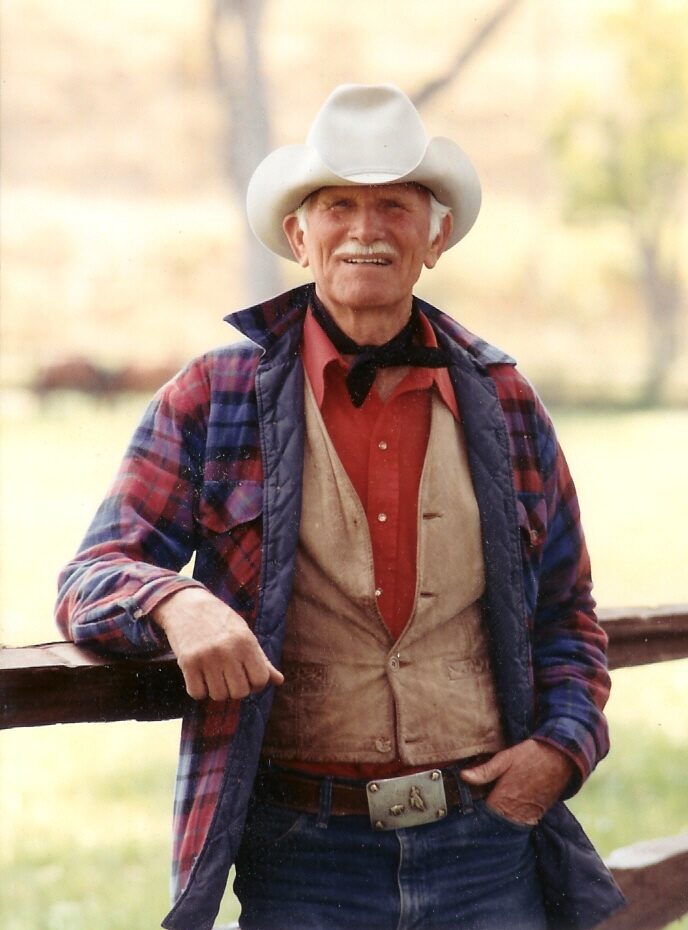 Over the span of his lifetime, starting at the age of ten, Jake became skilled in his CHOSEN work of cowboying. Though his dad was a hardworking farmer, and a respected teamster who raised Percherons for a while, as well as a good hand at figuring out not-so-good horses, Jake had other ideas. He said he caught a break after raising and starting a leppy colt which turned out to be pretty decent, and surprisingly fetched a big price from a man passing through, which led to a recommendation to hire onto a big outfit, the Pitchfork no less, where Jake got to break some of their good colts. He was the youngest on the crew, but he didn’t claim he was a cowboy, yet. That term took time and experience with cows to earn. He already knew that ranching had its hardships just like farming, but for Jake the idea of being around horses was that you also got to be around cows.
For over forty years, throughout the central California region, Jake ran cattle on leased ranches with his longtime partner G.B. Barry. Theirs was an enduring partnership, more like a brotherhood. They knew how each other thought and anticipated their next moves. All cattle business was conducted on a handshake, and no one ever accused either of them of reneging on a deal, even if it meant they lost money when the price of cattle quickly shifted, or cow feed went up. They also happened to pass away six weeks apart from one another from the same rare blood cancer, and both requested that their ashes be scattered in the same spot on the same ranch. His daughter and a few close friends will be riding over that spot to scatter rose petals in remembrance of this milestone anniversary.
One of our longtime wranglers at the Alisal barn, Horse Herd Manager, Mark Bohannon, knew Jake as well as anyone, first, because his dad had partnered with Jake in a saddle making business. Soon after returning from their army service, Jake and “Bo,” Travis Bohannon, built the first saddles Jedlicka’s ever sold. They opened a saddle shop of their own in Solvang. Jake also shod horses. It took a lot of extra work in related trades to support a cowboying lifestyle, and hope to raise a family. Incidentally, Mark’s dad cowboyed for the Alisal, and lived on the ranch with his young family when Mark was a toddler. Mark says, “I’m very grateful for all the opportunities Jake gave me over the years. He got me hired at both the cattle side and the guest side of the Alisal, plus a lot of daywork with his and Barry’s cattle business from King City to Santa Barbara.”
Jake helped others of his kind too. Another transplanted cowboy like himself, this one from Wyoming, credits Jake with being the lone soul who welcomed him into the tightknit ranching circle of the Santa Ynez Valley back in the late 1960’s and early 1970’s. That northern cowboy who migrated south for warmer weather stated, “I’d have turned around and gone back to snow country, if it hadn’t been for Jake!”
Back in 1946, when the ranch was first welcoming guests, Jake wrangled for this new venture of the Alisal’s. That was when wranglers ate with guests and “everyone knew everyone.” He also worked on the cattle side participating in many seasons of gathering and shipping, and was an interim advisor to the cattle operation after the Jackson’s longtime ranching superintendent, Mike Chrisman, retired, and Alisal cow boss, Bill Dutra passed away. Jake then went back to wrangling on the guest side, running the barn a time, or two, or three, and continued to pleasure folks with his story telling and poetry until the very last.
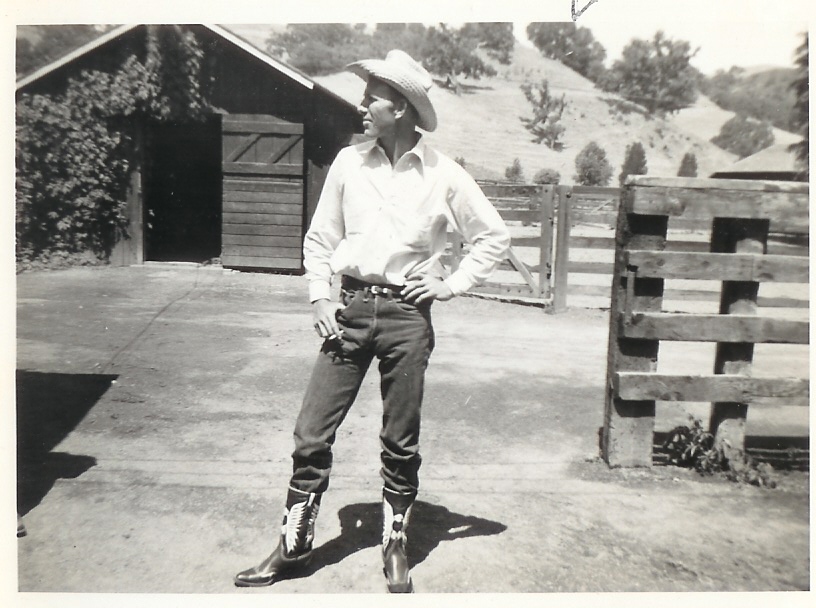 Caption: Jake in the Alisal horse corral circa 1946 wearing his Jedlicka’s handmade-to-order, “uptown’” boots which cost a month’s wages. His pant legs are tucked in with the boot tops showing, like a wrangler would wear them……or like someone who’s going to go to town to “pop the hem out of the gingham” (go dancing). “I was making $85 a month as a wrangler….LaVerne was working in housekeeping and made $65, and we were furnished three meals a day plus a cabin to live in. We were rolling in money. This was more than we had ever made in our life because we had no real expenses.”
1946 was the same year that Jake had been released from his assignment during WWII in New Guinea with the cavalry’s veterinary core. He and a few others took care of 1,600 head of mules. The army had hoped to transport supplies with them, but it proved to be impractical in the conditions there. With 160 – 180” of rain per year, Jake said he’d never seen so much mud! Then he served as a food inspector which gave him the fulfillment of saving soldiers from ptomaine poisoning which was a problem at that time. At the end of his overseas deployment Jake was reassigned to Santa Barbara where he landed at a Rest and Recreation facility for war worn soldiers where he ran the riding stable near East beach and the Bird Refuge for the soldiers’ use. It wasn’t long before he discovered the verdant grasslands just north of Santa Barbara over the mountains in the Santa Ynez Valley, which were very different from the dust blown flats of west Texas. In his book, “I’ll Be Satisfied,” Jake wrote “We’d had early rains that year and the grass was knee-high. When we came over the pass and I saw all that grass I couldn’t believe what I was seeing. It looked like heaven to me.” It wasn’t hard for him to stay and so many of us are glad he did.
Jake was the type who showed up wherever needed. He worked ceaselessly, at a cowboy pace, and made do with whatever he had. “He would help anyone, anytime, without expecting anything in return.” Norma remembers, “The CHP office calling our house day or night when someone’s cattle would get out onto the road. Dad usually knew exactly who they belonged to, and he’d head out to help round them up.” Like his fellow ranchers when it came time to gather, brand, or ship cattle, “he’d be out the door headed to work long before daylight.”
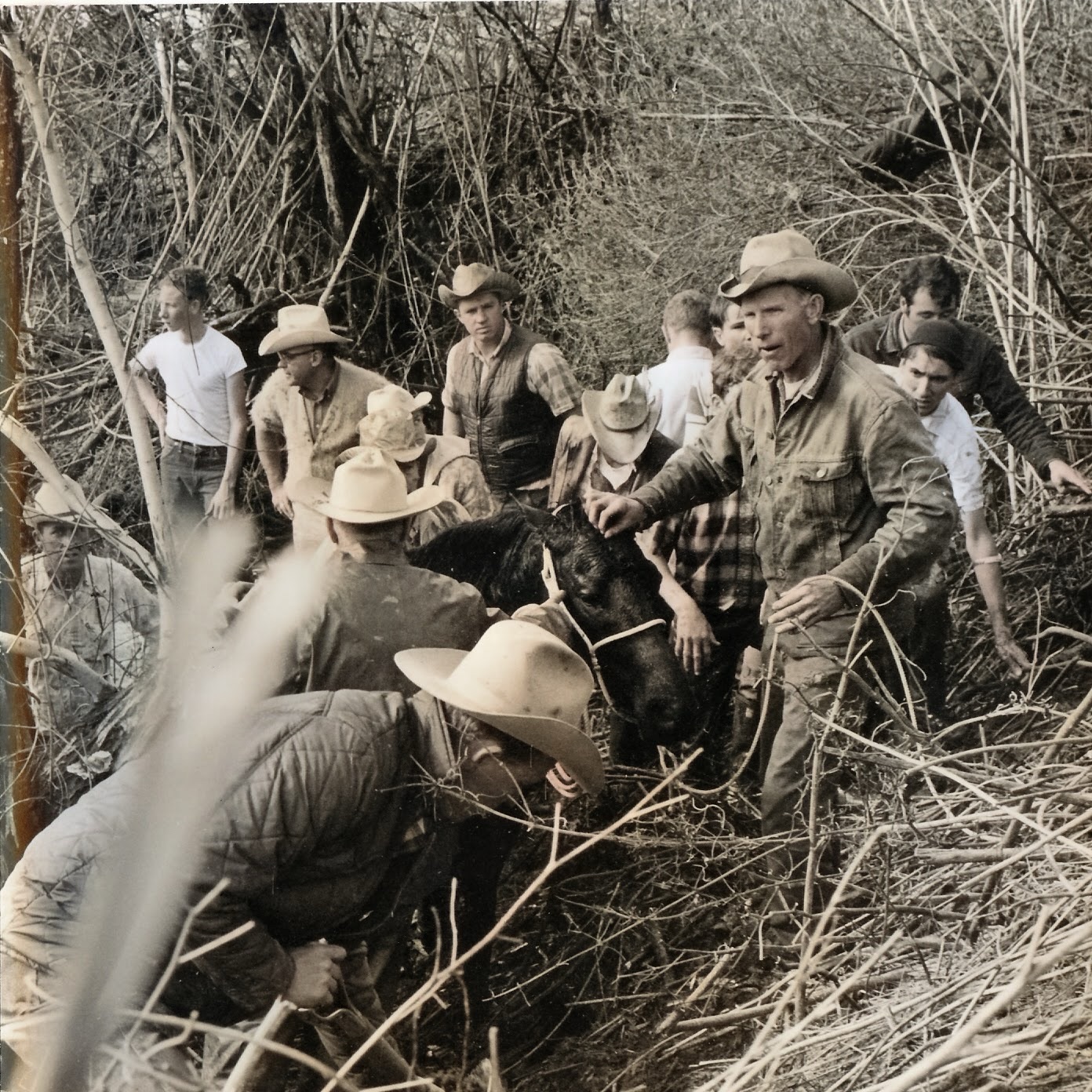 Caption: In the disastrous 1969 flooding of the Santa Ynez River, which caused heavy losses to many ranchers up and down the river from Gibraltar Dam to Lompoc, Jake pitched in to help rescue a played-out horse from the river’s edge on the Alisal Ranch. As you can see the cowboy community showed up for one another. Out of 32 horses that got washed away from the newly built Thoroughbred facility, which was where the River Golf Course now sits, 30 were saved, many by having to dig an escape route through the mud and debris. Two were too badly injured and had to be euthanized, but the Alisal fared better than many other ranchers who lost significant numbers of cattle and horses.
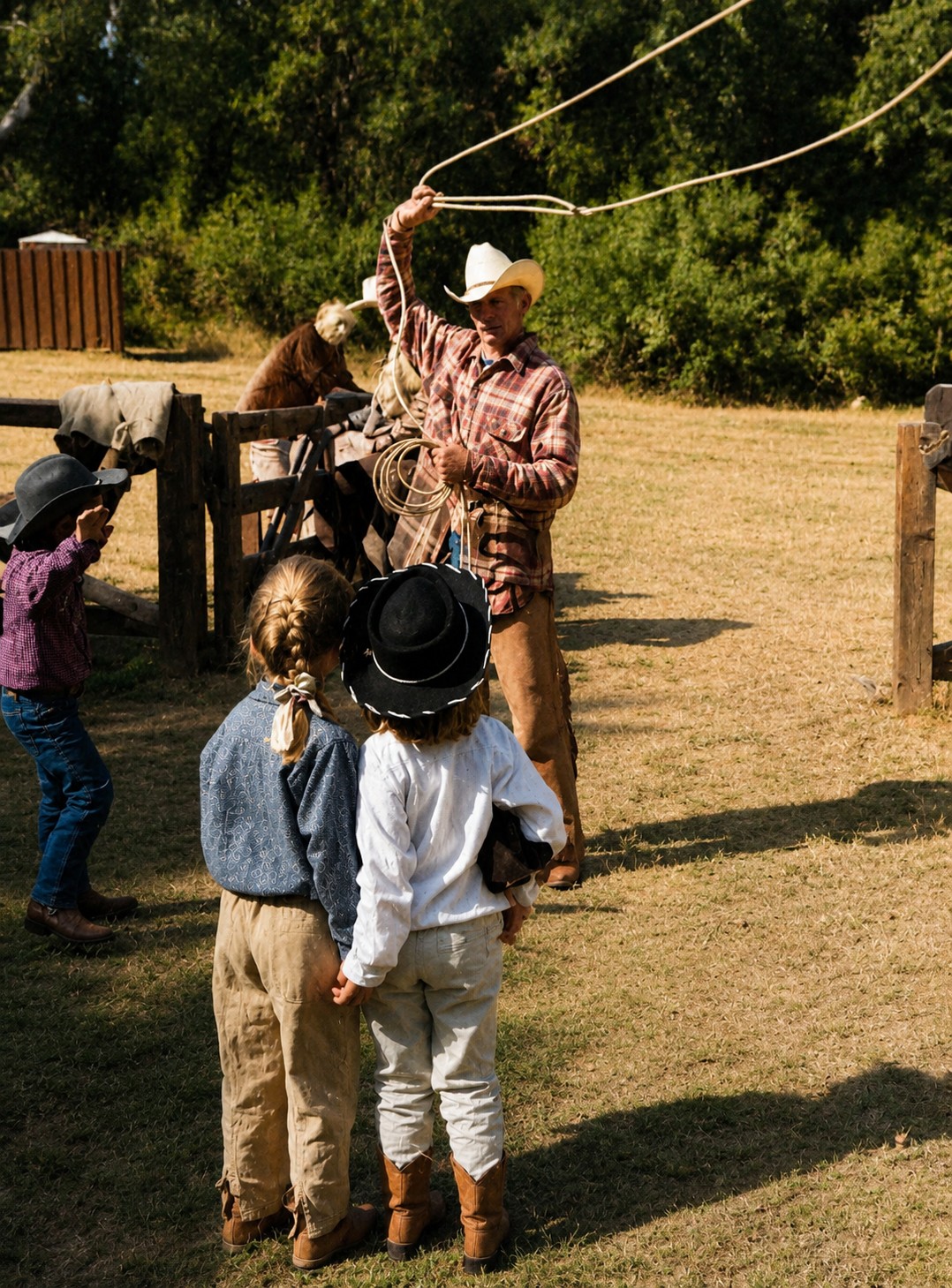
Jake’s positive influence was most apparent when he was around kids. He loved being with them and they loved hearing his stories and poems. He was living history on display. He offered a look into a life they would never experience except through him. Recognized by one of the valley’s volunteer organizations for his contribution of time and talent to children was testament that his time ‘not working’ was well spent. At the Alisal, the kids wanted to come to the barn to say “hi” to Jake as soon as they popped out of the car. Jake got to see lots of kids returning year after year, turn into adults with kids of their own. He always had time for them, and with a rope in his hands, he’d deliver some tips on swinging a loop, or a life’s lesson in a short story of something he had experienced.
One child’s life Jake particularly impacted was a boy from England who was declining with Leukemia. His name was Sam, and his last wish was to travel to America to meet a real cowboy. A letter was received by the Alisal, and when Jake was shown the letter it “hit him right in the face.” He convinced the manager that they should invite this child to the ranch. So, Sam came and received Jake’s old hat and a rope, and precious time spent with someone who spoke “cowboy.” After Sam’s passing his little brother was born whose name became Oliver “Jake.” This touched Jake deeply.
Later in years Jake discovered that his poems, which he started writing while in the service, were well received by audiences near and far. He was an invited participant, and enjoyed traveling to Cowboy Poetry gatherings during their inception. One of his road trip companions for these adventures was friend, and the Alisal’s own wrangler and balladeer for ten years, Dave Stamey. Jake and Dave teamed up to become breakfast ride favorites, entertaining us well with song, poetry, and humor. Jake’s published poetry collections are more than cowboy lore; they are a historical and insightful recollection of life as Jake lived it.
The thing that made Jake stand out as a person most admirably in my mind, was his ability to bring humor to every situation. Whether it was dire, like the little boy dying of cancer who wanted to meet a cowboy; or catastrophic, like the raging flood that swept away livestock; or an enduring burden such as the years long extended droughts we get around here, or the most enduring challenge of all, the everyday test of trying to make ends meet in his chosen and difficult field; in all those situations, as well as the mundane, long, hard, dusty days of working cattle, or, the pleasant days shooting the breeze, riding with Alisal guests, Jake took the humorous trail through life and lifted others with him. Perhaps it was his hardscrabble start in life. His good parents struggled against many odds in the dust bowl era of west Texas, raising a houseful of kids, so I imagine he had to learn that you had better see the lighter side of life if you were to survive. Humor helped carry them. Looking back from my perspective, every time I was around Jake, he showed me another way of looking at things, and I learned a great deal from him, though I regret I didn’t slow down enough to listen better, and laugh more, like he did.
You didn’t have to delve deep into Jake’s humor to find his corrective humor. As a teenager, Norma got her truck stuck up to the axels in the mud along the shoulder of the road. Norma relates that her dad was “…very direct. You always knew where you stood with him, and he had a way with words that stayed with you.” You may not have wanted to hear what he had to say, but it was what you needed to hear, and it was said in a way only Jake Copass could say it. Arriving at the scene to pull Norma’s truck out of the mud, he said, “Ain’t nobody told you it’s been raining lately?” Heh, no reprimand or harsh words, just a clear message, and it was kind of funny while it was true. “And that’s how the cow ate the cabbage!” Norma reports that she never made that mistake again.
As a cowboy, Jake was legendary for his fearlessness. It was said of him by another cowboy, “I’d hate to have to try to beat him to the bottom of a hill to catch a wild cow!” Jake told a story of running the saddle horse string up on the mountain to graze in the slow season under what later became Reagan’s ranch. He took some guests with him to bring in six head that kept escaping in the steep and rugged terrain known as “the Indian Trail.” Those horses had figured out how to circle back up to stay on the mountain by sneaking down a hidden trail off a bluff and it was impossible to get around them with the tall brush on one side and the steep bluff on the other. After several tries to get them past that spot Jake figured if those horses could go down that bluff why he and the borrowed horse he was on could do it too. The horse belonged to the ranch’s manager, Mr. Austin, and his name was White Cloud. Jake gave that “good ol’ grey” his head and went for it with all that horse had, but the trail kept getting steeper as they went, which you couldn’t see from above. At one point Jake said he thought White Cloud was going to go over on him, hind end over front. They missed turning the six head, but thankfully White Cloud kept his feet under him, and stopped just barely short of going over the drop off, while Jake grabbed an oak tree branch overhead to make an emergency exit. After Jake “cleaned his pants” another attempt was made and that time the wayward six head mysteriously and peacefully went where they were supposed to go. That was fearless Jake. I’ll bet Mr. Austin was glad his good horse didn’t go over the edge with Jake too!
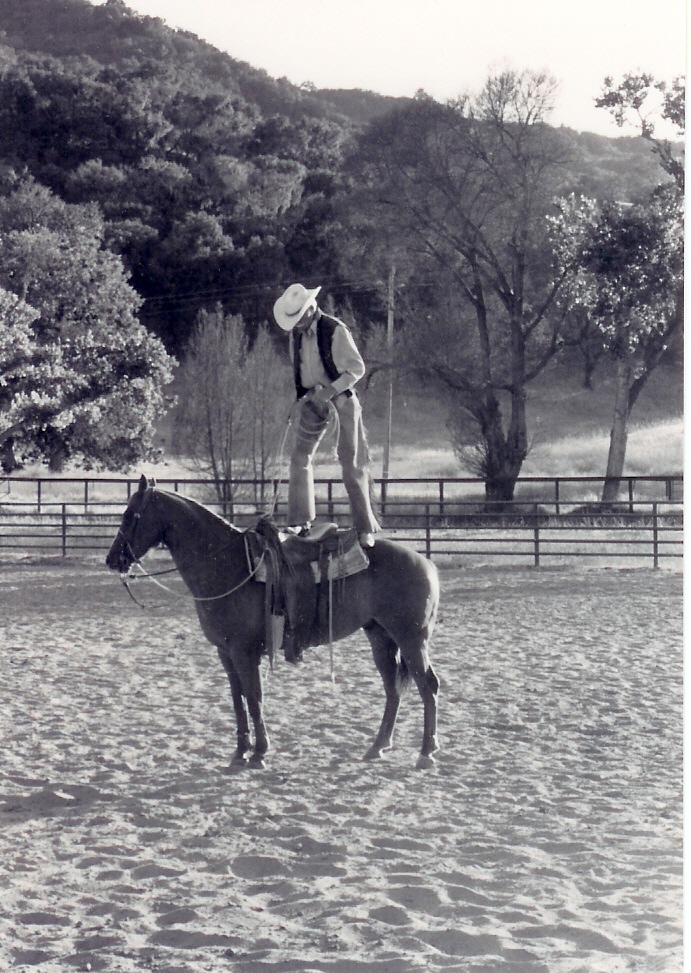 Caption: Jake on Doc in the Alisal arena. “I was 73 when this picture was taken. I call it my “showing off picture” and I was fixin’ to make a horse catch.”
All totaled, Jake spent six decades associated, off and on, with the Alisal. He added his own legacy to that of the ranch, and the Santa Ynez Valley. Those of us who were graced to know him still miss his bright presence. We at the barn especially miss seeing Jake in the morning with a coffee cup in his hand, standing over the fire pot sporting a twinkle in his eye as he quipped and teased us, regaled us with his colorfully told stories, and taught us well with his “how the cow ate the cabbage” approach. Jake’s parting words on many days were, “A dollar a day, and the work ain’t hard!” That was his philosophy. If you love what you do, you’ll do it for anything, and it won’t be a burden. We can all hope to make such choices in life. And…. we hope to see you down the trail on the other side, Jake.
I’ll be Satisfied
You can have my part of city life
With all the comforts of its kind
But I prefer the open spaces
Where the sun is sure to shine.
You can have that stuffy cottage
Down on Fifth Avenue
I’ll be contented with a hut of breezes
With a roof of sky so blue
You may have a fluffy pillow
And a fancy feather bed
I won’t complain with a bed roll
And some sage brush at my head.
I guess life is what you make it
In the city, on the farm
But me, I’m sticking to the country
To live and die where I was born.
Sgt. W. Jake Copass, 1943, New Guinea 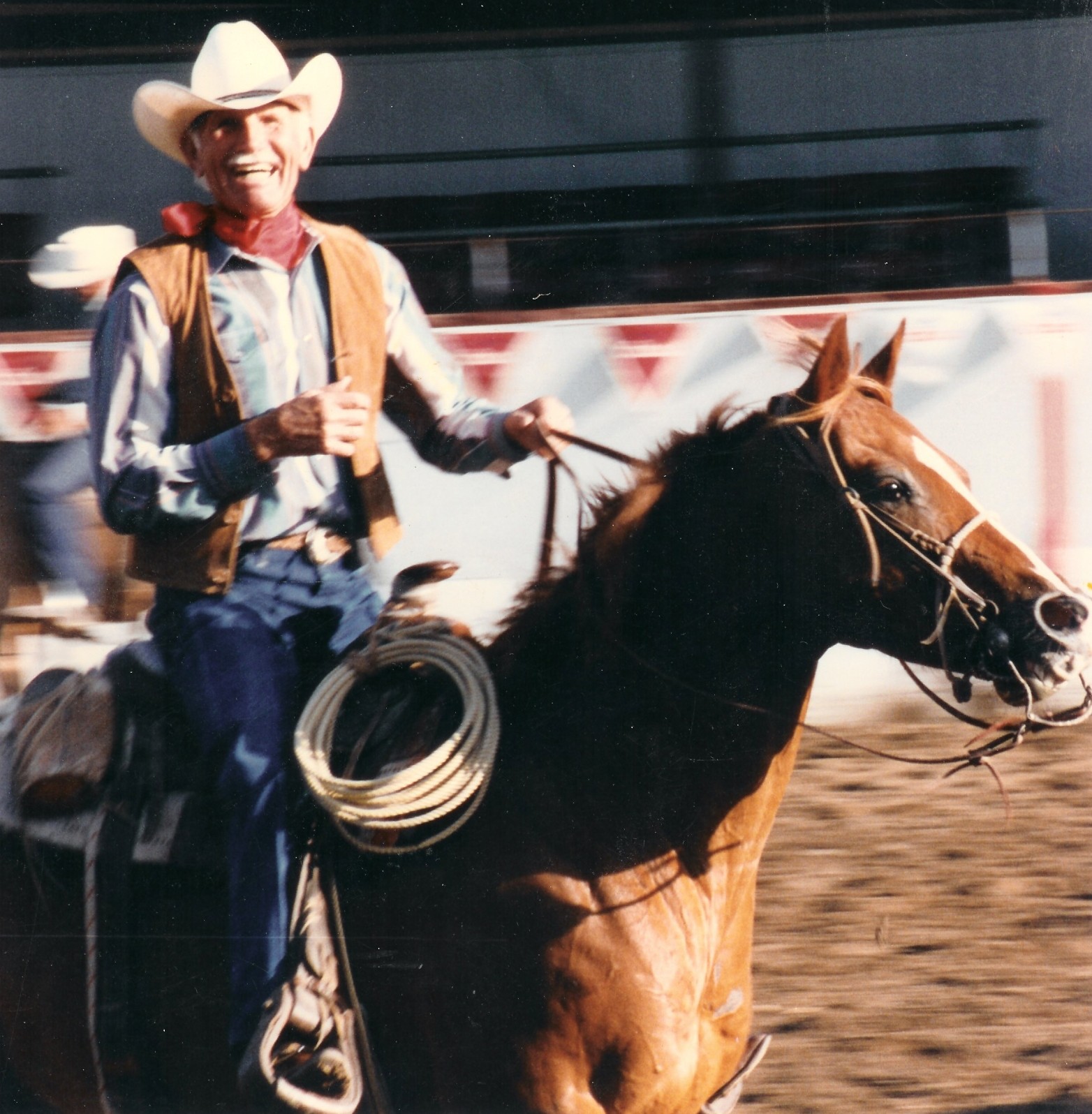

September 26, 2026
What does a day away from your screen look like? At Alisal Ranch, it might begin on horseback and end with a long conversation by the fire.
August 8, 2026
Plan a horseback riding vacation at Alisal Ranch in California’s Santa Ynez Valley. Discover scenic trail rides, riding options for every level, what to pack and how to prepare for your stay.
July 17, 2026
The Santa Ynez Valley’s legendary retreat marks its 80th anniversary with exclusive guest experiences, commemorative product launches, a new history book, and more.